
The Gilded Crossroads: Trump’s ‘Independence Arch’ and the Making of an American Pantheon


On the hallowed axis between the Lincoln Memorial and Arlington National Cemetery—where the weight of American sacrifice meets the marble memory of its greatest emancipator—Donald Trump has proposed a monument that feels less like a tribute and more like a testament to a particular vision of national glory. The “Independence Arch,” a 250-foot colossus planned to commemorate the nation’s semiquincentennial, would bear the inscription “One Nation under God” across its gilded facade. Newly released mock-ups reveal a structure dripping with symbolic ambition: a winged Statue of Liberty figure—part goddess, part angel—towering above four golden lions, flanked by soaring eagles. It is a design that borrows from Paris, London, and ancient Rome, yet aims for something distinctly American: a fusion of republic and temple, liberty and empire, prayer and power. The arch echoes the Arch of Titus, built in 81 AD to celebrate Rome’s conquest of Jerusalem—a historical resonance that may be unintended but is impossible to ignore. In placing this monument between the mournful dignity of Lincoln and the silent rows of Arlington’s fallen, Trump has chosen a landscape already thick with meaning. The question is whether the arch will speak the language of humble gratitude or triumphant assertion.
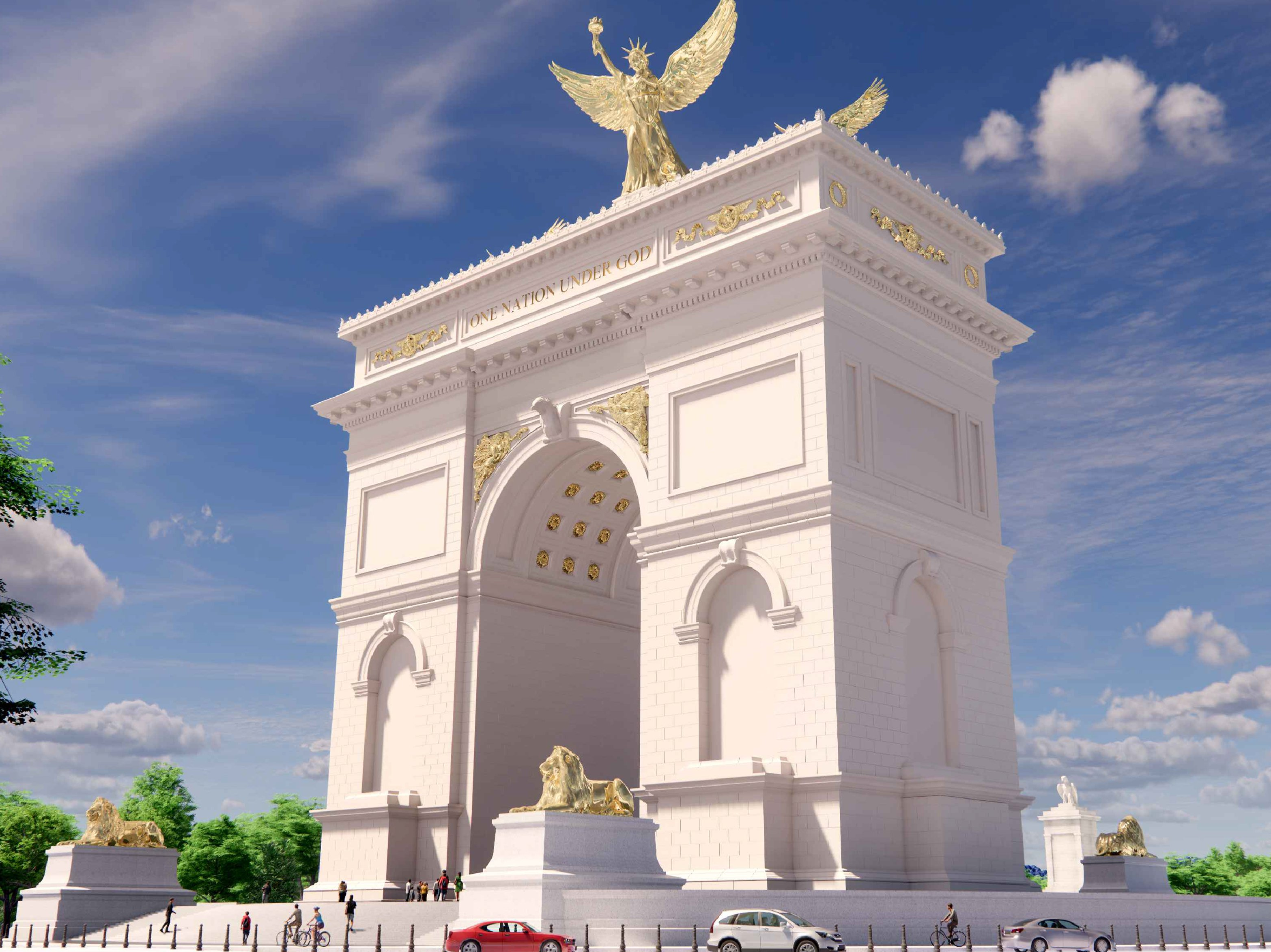
Critics will note that triumphal arches traditionally mark military victory, not national anniversaries. And in an era of deep division, the phrase “One Nation under God”—added to the Pledge of Allegiance in 1954 as a Cold War rebuke to “godless communism”—carries political weight that cannot be airbrushed into nostalgia. Supporters, however, will see a necessary reclaiming of civic faith, a bold architectural declaration that America’s founding ideals remain tethered to divine providence. The proposal now awaits approval from the Federal Commission of Fine Arts, a body not known for embracing bombast. But regardless of whether the arch is ever built, the imagery alone offers a fascinating portrait of a political movement’s self-understanding: golden lions, winged liberties, and a God invoked not in whispers but in towering gilded letters. It is less a monument to history than a monument to aspiration—a nation still arguing over whose God, whose liberty, and whose story gets etched into the eternal stone of the capital’s most sacred ground.