Divine Dimensions: World’s Largest Bible Page Unveiled in Germany, Echoing Gutenberg’s Holy Revolution


Mainz, Germany — In a spectacle of faith and history, Germany’s Mainz Cathedral has unfurled the world’s largest Bible page—a monumental 16.4 x 23.6-foot masterpiece—honoring the 625th birthday of Johannes Gutenberg, the visionary whom God used to ignite the Reformation and flood the world with Scripture.
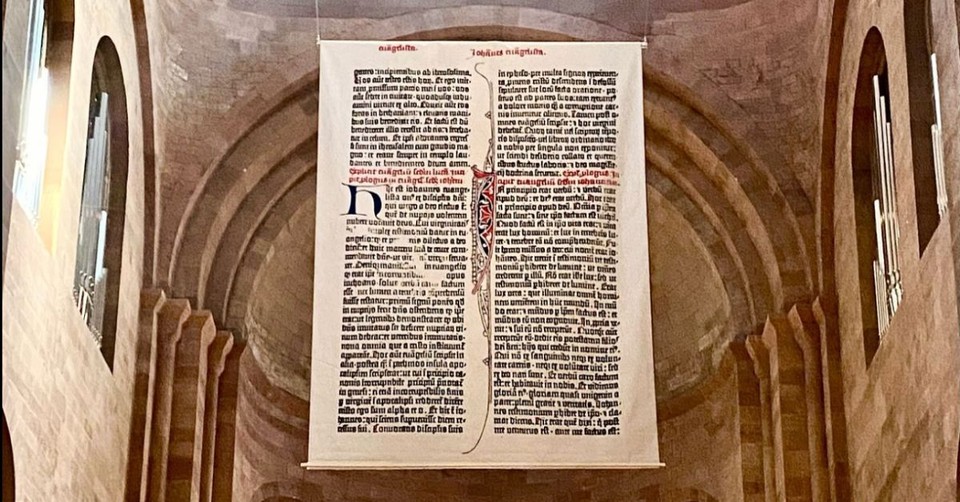
The breathtaking exhibit, unveiled on April 28, features the first page of the Gospel of John from the Shuckburgh Bible, a rare Gutenberg edition, printed in stunning detail using traditional letterpress techniques. The towering scripture sheet now dominates the cathedral’s east choir, a divine juxtaposition of ancient reverence and revolutionary innovation.
“A Hook for Heaven’s Story”
Rev. Henning Priesel, Dean of Mainz Cathedral, called the display a “spiritual magnet” for visitors. “In the literal sense, this page is the hook—drawing young and old into the living Word,” he declared. “Where else but in Mainz, Gutenberg’s own city, could such a tribute stand?”
The project, a collaboration between the International Gutenberg Society and the city, saw master printer Markus Kohz and his team painstakingly recreate the page during Mainz’s Kultursommer festival, using Gutenberg’s original movable-type method. The spectacle drew crowds, a vivid reminder of how one man’s invention shattered the chains of spiritual ignorance.
More Than Ink and Parchment
Beyond the exhibit, the cathedral has transformed into a hub of sacred celebration. A special reading corner in the All Saints’ Chapel invites children to explore rare Bible editions, while an accompanying exhibition, The Whole World on Parchment, showcases medieval choir books—each a testament to the enduring power of God’s Word.
Mainz Mayor Nino Haase marveled at the fusion of past and present: “This isn’t just paper—it’s a bridge across six centuries. Gutenberg didn’t just print books; he printed freedom.”
A Symphony of Praise
The festivities crescendo on August 24 with a cathedral concert featuring Mendelssohn’s Lobgesang (“Hymn of Praise”), performed by 200 voices and the Mainz Philharmonic—a fitting tribute to the man who made the “Word of God accessible to all.”
As the exhibit runs through August 31, pilgrims and skeptics alike are left to ponder: Was Gutenberg merely an inventor—or an instrument of Providence? In Mainz, the answer echoes from the cathedral walls: “The grass withers, the flower fades, but the Word of our God stands forever.” (Isaiah 40:8).