Bold Stand or Fading Faith? Episcopal Bishop’s Fiery Rebuke of Trump Sparks Clash of Worldviews

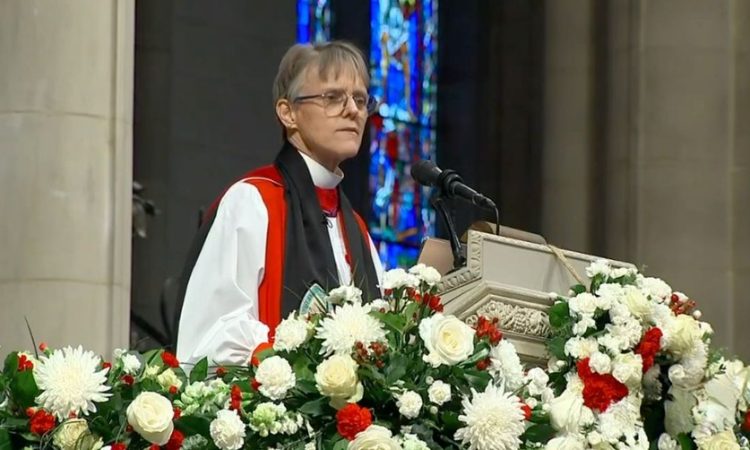
In a moment that captured the nation’s attention, Right Rev. Mariann Budde, the Episcopal bishop of Washington, delivered a scathing admonition of President Donald Trump during an interfaith service at the National Cathedral on Tuesday. Her bold critique of the President’s immigration policies and stance on transgender issues resonated far beyond the ornate walls of the cathedral, igniting a fierce debate about faith, politics, and the role of the church in modern America.
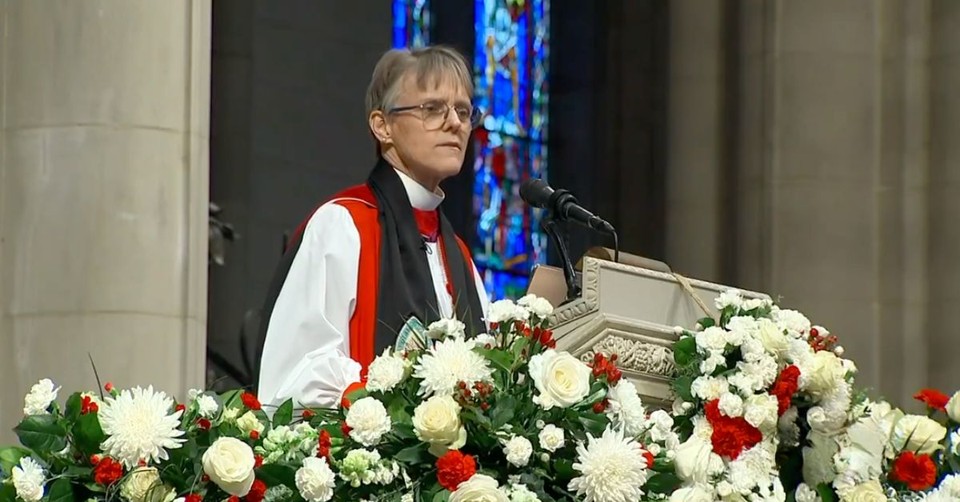
Addressing Trump and Vice President J.D. Vance directly before a live audience and millions of television viewers, Bishop Budde implored the President to act with compassion. Her words struck at the heart of the nation’s ongoing cultural and political divides.
“Mr. President, millions have put their trust in you,” Budde began. “In the name of our God, I ask you to have mercy upon the people in our country who are scared now. There are gay, lesbian, and transgender children in Democratic, Republican, and independent families—some who fear for their lives.”
Budde’s speech shifted to immigration, highlighting the essential contributions of undocumented immigrants to the nation’s workforce. “They may not be citizens or have the proper documentation, but the vast majority of immigrants are not criminals. They pay taxes and are good neighbors,” she said, urging for a more humane approach to immigration policy.
The bishop’s remarks quickly went viral on social media, drawing both praise and condemnation.
Divided Reactions from Faith Leaders
Albert Mohler, president of the Southern Baptist Theological Seminary, criticized Budde’s comments, framing them as emblematic of the theological liberalism that has characterized the Episcopal Church in recent decades.
“What she addressed to the president was basically the voice of liberal culture,” Mohler said on The Briefing, his popular podcast. “Liberal at the start, you’ll be liberal at the end, and at every point liberal in the middle.”
Others, like Fox News commentator Brit Hume, echoed this sentiment, suggesting that Budde’s words may have alienated more people than they inspired. “She doubtless thought she was ‘speaking truth to power,'” Hume tweeted. “She was almost certainly chasing more people out of the dying Episcopal Church.”
Indeed, the Episcopal Church has seen its membership plummet from 3.4 million in the 1960s to less than 1.6 million today, a statistic often cited by critics who argue the denomination’s progressive stances have contributed to its decline.

Political Fallout
U.S. Rep. Andy Barr (R-Ky.), a self-described conservative Episcopalian, also condemned Budde’s comments, accusing her of politicizing a sacred event.
“By disregarding President Trump’s appointment of Scott Bessent, a brilliant, openly gay man, to serve as Treasury Secretary, and Elon Musk, a genius, first-generation legal immigrant, to lead the new Department of Government Efficiency, Bishop Budde’s gratuitous criticisms ring hollow,” Barr said.
President Trump, not one to shy away from confrontation, responded on Truth Social with characteristic bluntness. “She failed to mention the large number of illegal migrants that came into our Country and killed people. … She is not very good at her job! She and her church owe the public an apology!”
The Broader Context
Budde’s remarks come on the heels of Trump’s signing of two controversial executive orders. One reasserts a binary view of gender, stating plainly: “It is the policy of the United States to recognize two sexes, male and female.” The other imposes stricter immigration policies, intensifying the already polarized national discourse on the issue.
To Budde’s defenders, her words were a prophetic call to justice, a reminder of the church’s responsibility to advocate for the marginalized. To her critics, they were evidence of a denomination disconnected from both biblical orthodoxy and the majority of Americans.
A Church at a Crossroads
This public clash has spotlighted the growing chasm between progressive and conservative branches of Christianity in America. While Budde’s supporters celebrate her courage, her detractors see her as a symbol of a fading institution more concerned with cultural relevance than spiritual revival.
The question remains: Can the Episcopal Church bridge this divide, or will it continue to dwindle in influence as the nation’s religious landscape shifts?
For now, the Right Rev. Mariann Budde stands undeterred, her words reverberating as both a rallying cry for change and a lightning rod for controversy. Whether history will judge her admonition as courageous or misguided is a verdict yet to be rendered.